
|
Contents
|
An imporant factor in the area efficiency of CPV arrays is their light-capture efficiency. This factor, sometimes termed aperture efficiency, is the complement of the energy loss due to light falling between the CPV elements comprising an array. The ArcSolTM CPV element is designed to optimize this factor, providing better than 97 percent light-capture efficiency throughout its tracking range, and contributing to the ArcSol panel's exceptional overall energy conversion efficiency. This analysis documents the use of a simulation tool, GapTrack, to estimate ArcSol's light-capture efficiency.
Maximizing the light-capture efficiency of tracking arrays is the subject of the paper Area Efficiency, Light Capture Efficiency, and their Maximization in Solar Tracking Arrays. It examines such efficiency for arrays of various light-capturing shapes, supported by two-axis mounts and spaced at the minimum possible distance to avoid collisions. Using GapTrack, it compares the light-capture efficiency of several common plane-tiling shapes to that of a member of the ArcSol shape family. The present paper examines the light-capture efficiency of a representative series of members of the ArcSol shape family.
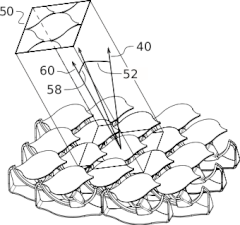
|
| The simulation shows sun's-eye views (50) of a small region of an ArcSol array of CPV elements, over a range of tilt angles. The sun lies on the center element's normal axis (60), which is tilted away from the array's normal axis (40) by the outer-axis tilt angle (52) and the innter-axis tilt angle (58). The simulation independently varies each tilt angle in 5-degree increments, where the outer-axis angle varies by row and and the inner-axis angle varies by column. |
The following pages show the results of using GapTrack to simulate the light-capture efficiency of two-axis tracked arrays of each of nine different members of the ArcSol shape family, where the family member is specified by an elongation parameter between 0.8661 and 1.02. In each case, the inner- and outer-axis tilt angles are varied from zero to 45 degrees in five-degree increments.
The simulation shows that the overall light-capture efficiency increases slightly as the elongation parameter increases. In no case, however, does the efficiency drop below about 97 percent, or that for the zero-tilt-angle case where the loss is due to the constant inter-tile spacing of two percent of the shape's width.
The ArcSol shape is a one-parameter family of shapes that describes the profiles of light-capture elements in zero-collision asynchronous two-axis sun-tracking arrays having maximal light-capture efficiency. The shape family was determined by imposing the requirements that each shape, when mounted for two-axis pivoting about its center:
The second requirement is equivalent to the provision that the shape:
This relationship between the shape and its volume of motion, taken together with the tiling arrangement of the shapes when oriented in the array-normal position, implies that such volumes of adjacent elements are non-intersecting and therefore adjacent shapes cannot collide, no matter how they move.

This relationship holds true for all members of the one-parameter family of ArcSol shapes, whose derivation is described in the ArcSol patent application.