The ArcSol Panel is filled
with an array of ArcSol CPV Elements --
compact heliotropic units whose reflective optics
have nearly perfect light-capture efficiency,
both within and between elements.
The novel one-piece optic and innovative mount
are unified by the electronics, which provides closed-loop
heliostatic orienting based on the electrical potentials of the cells.
| Feature |
Benefits |
|---|
| Efficiency |
Economy and Reliability |
|---|
Folded Reflector With Embedded Receivers ("OptiFold")
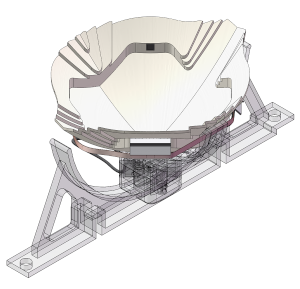
|
- Eliminates light obstructions within reflector
- Single-bounce light concentration
minimized optical losses
- No refractive optics
- Low cell incidence angles:
98 percent less than 30 degrees
- Compact shape has an aperture profile
that is entirely tangent to the equator of
the close-packing volume of motion it sweeps out as it pivots,
maximizing light-capturing efficiency
- Four distributed hotspots enable efficient heat dissipation
by reflector body
- Cell mounts and additional heat sinkage
fit underneath reflector body and within its clearance volume
|
- Single-part optical system
serves as platform electronics and mounting arc
- Shallow-walled no-undercut shape allows economical manufacture
as stamped or molded part
- Curvature and ridges afford accurate shape retention
in thin, lightweight material
- Reflector can serve as heat sink, reducing part count
|
Angular Positioner and Tiling Optics Shape ("ArcSol")
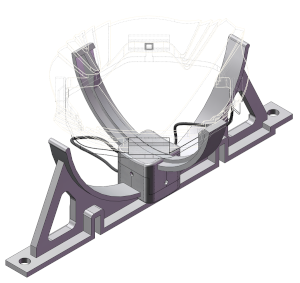
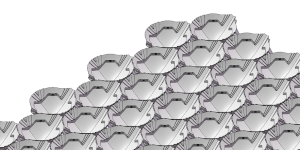
|
- Supports zero-collision asynchronous two-axis motion of CPV elements
in close-packed arrays whose apertures tile in the normal position,
and which
capture more than 97 percent of incident light
throughout the tracking range
- Allows 120 degrees of motion about each pivot axis
- Positioner and articulating arcs present no obstruction to light,
fit under optics and within optics' clearance volume
- Avoids tracking errors from mechanical linkages
- Mechanical independence of elements
allows flexible configuration of arrays
and their containers, such as non-planar aerodynamic shapes
|
- Combines support and motive functions,
minimizes part count and bulk
- Allows easy calibration-free replacement,
by sliding positioner off and on base arc
- Malfunctions are isolated to elements,
have only marginal impact on panel output
- Articulating arcs are manufacturable as shapes
integral to reflector and base
- Positioner houses motors and electronics
in compact protective shell
|
Integral Sensing -- Elements individually orient based on cell outputs
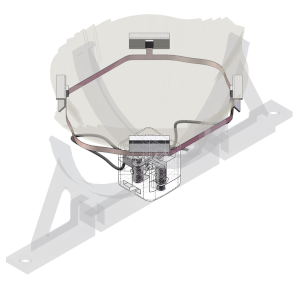
|
- Per-element cell-based tracking allows maximum accuracy,
concentration ratio,
and compensates for mechanical imperfections in mount and optics
|
- Replaces extra sensors with (cheaper) intelligence
- Accuracy-enabled higher concentration ratios
allow reduction of cell sizes and total PV material
- Element microcontroller records, reports performance of cells,
flags elements needing replacement
- Tracking accuracy does not depend on precision of mount,
allowing construction from cheap injection-molded parts
|