
Solar panels have two dominant performance metrics: economy and efficiency. These metrics are commonly measured as ratios of a panel's peak power output to its purchase cost (economy) and to its aperture (efficiency). For PV panels, peak power output is the electrical specification peak watts (Wp). Given that, economy is computed as Wp per unit of equipment cost, and efficiency is computed as Wp per unit of maximum aperture (corresponding to the panel's frontal area).
Whereas comparisons of solar panels on the basis of economy are straightforward, comparisons on the basis of efficiency are often muddled by the mixing of different measures such as module efficiency and cell efficiency. A comprehensive comparison of existing PV panels that uses a consistent method to measure efficiency and examines the relationship between economy and efficiency could provide important data on the economic value of efficiency. The stronger the inverse correlation between these two variables, if any, the stronger the economic value indicated for efficiency. The present study plots panel models and types of panels in the two-dimensional space of value and efficiency to examine the relationship of these two variables.
A database was created to record, for each of a broad cross-section of available PV panels, data including:
PV panels are typically manufactured and sold as product series, each series having three to seven models sharing the same cell type and physical characteristics such as dimensions and weight, and distinguished by power output. Thus it was natural to organize the database as three types of objects:
PanelFamily name:SW155-175mono manufacturer:SolarWorld type:MCSi dimensionsMm:1610*810*34 weightKg:15 url:http://lib.store.yahoo.net/lib/wind-sun/SW-175-Mono.pdf Panel model:SW-175 familyName:SW155-175mono power:175 Source panelModel:SW-175 priceD:555 date:2009.10.11 url:http://store.solar-electric.com/so175wamosop.html |
The database is stored as a set of flat-files containing entries describing objects of these types. The excerpt to the right contains three entries: the first specifies the panel family designated 'SW155-175mono'; the second specifies the panel model 'SW-175' belonging to that family; and the third gives a price quote for that model.
The database is instrumented with different views of its contents. One view is the following list of panel models with links to the specifications and quote sources.
Each row in the table corresponds to a model of solar panel. The Specs column provides links to the specification sheets describing the physical and electrical characteristics of each model of panel, usually as part of a family of models sharing the same physical characteristics. The Economy column provides links to sources of price quotes, if any, for each model of panel.
Some panel specifications provide module and/or cell efficiencies, and the database records these when present. However, in order to provide consistent performance metrics, efficiencies reported by views of the database are computed by dividing its peak power output by frontal area, where a panel's frontal area is found by multiplying its height and width dimensions.
The main objective of this survey is to examine the relationship between the two most important performance characteristics of PV panels, which can be described by the dependent variables 'efficiency' and 'economy'. Alternatively, they can be described by the two related dependent variables, 'space' and 'capital', which are the inverses of efficiency and economy, respectively. Whereas efficiency and economy measure panel performance in the domain of value to the customer, space and capital measure their performance in the domain of resources expended or footprint. The two domains are simply inverses of each-other.
| Domain | ||
|---|---|---|
| Resource or Footprint (smaller is better) |
Value (larger is better) |
|
| variable: description: typical units: |
Space Occupied space per unit of output m2 / kWp |
Efficiency Output per unit of space occupied kWp / m2 * 100 (percent) |
| variable: description: typical units: |
Capital Equipment cost per unit of output $ / Wp |
Economy Output per unit of equipment cost Wp / $ |
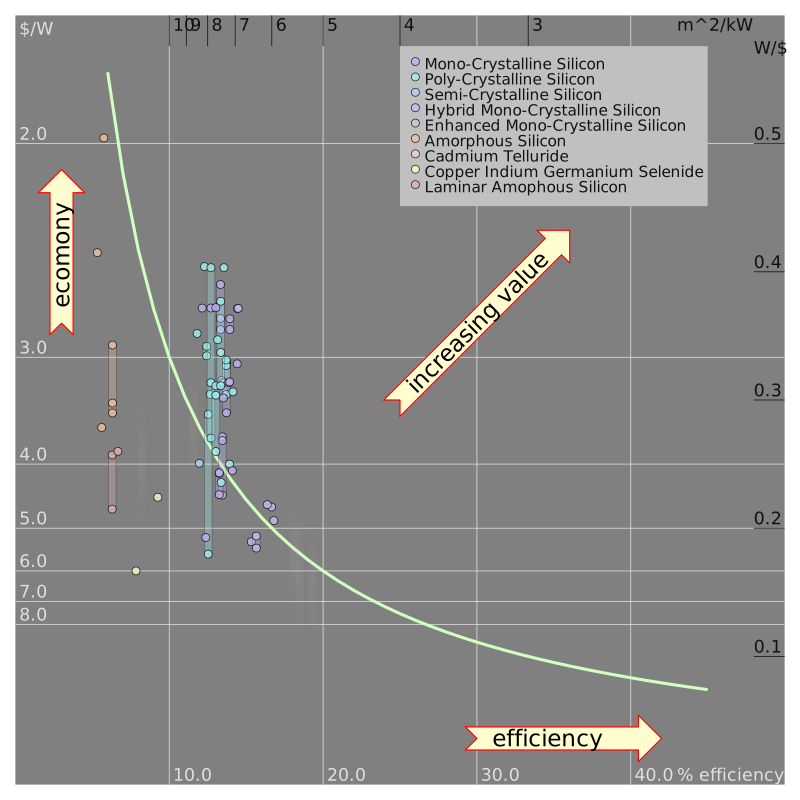
The relationship of the pair of dependent variables -- whether space and capital or efficiency and economy -- is visualized by plotting the locations of solar panels in a two-dimensional space, where the variable relating to occupied space maps to the horizontal axis, and the variable relating to equipment cost maps to the vertical axis. The horizontal coordinate for a given panel model is well-defined by its physical and electrical specifications. The vertical coordinate is a function of the price, which typically spans a range when there are multiple quotes. In the plots, a panel model appears as a disk when it has one quote, a series of disks connected by a vertical bar when it has multiple quotes, and a faint vertical bar when it has no quotes and it is assigned an estimated price range.
Graphical views of the database based on the two-dimensional domains of footprint and value enable visualizing the relationship of the dependent variables.
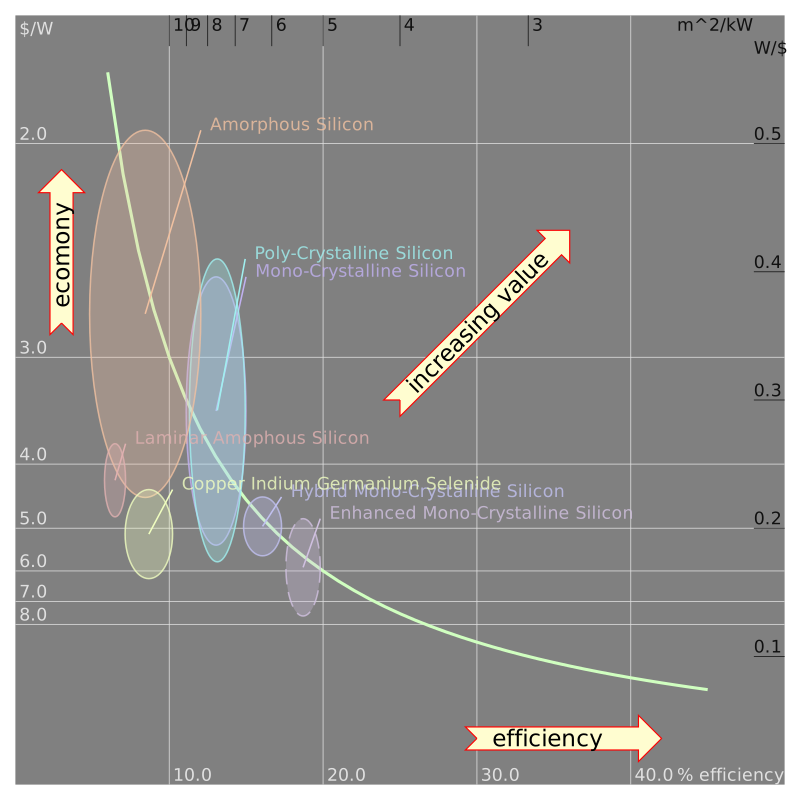
One set of views plots positions of panel models in the two domains and another set of views plots the extent of groups of panel models sharing the same PV cell types.
| Resource domain | Value domain | |
|---|---|---|
| Panel models | 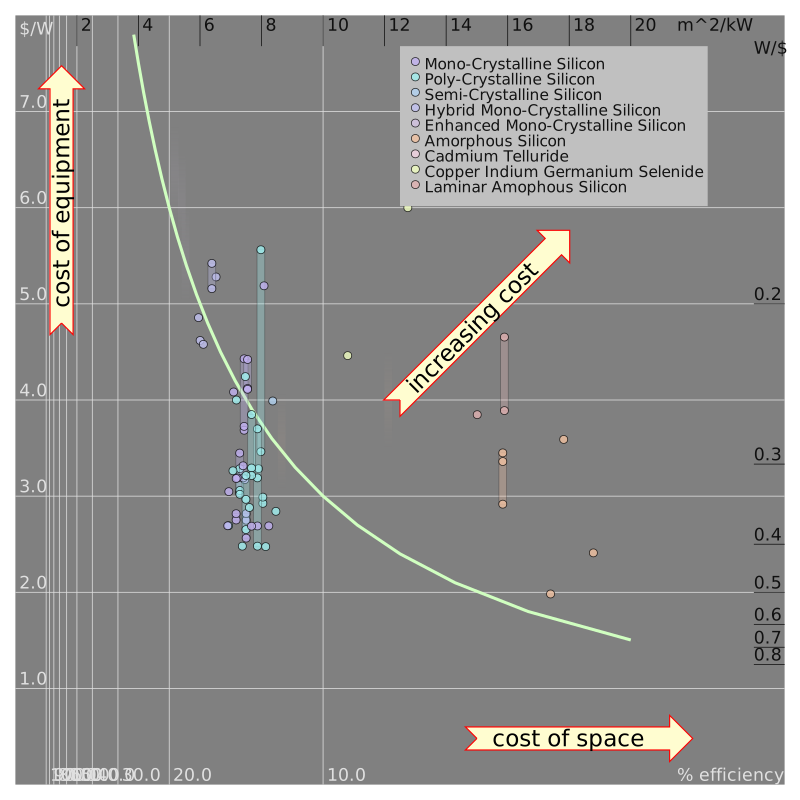 |
 |
| Panel types | 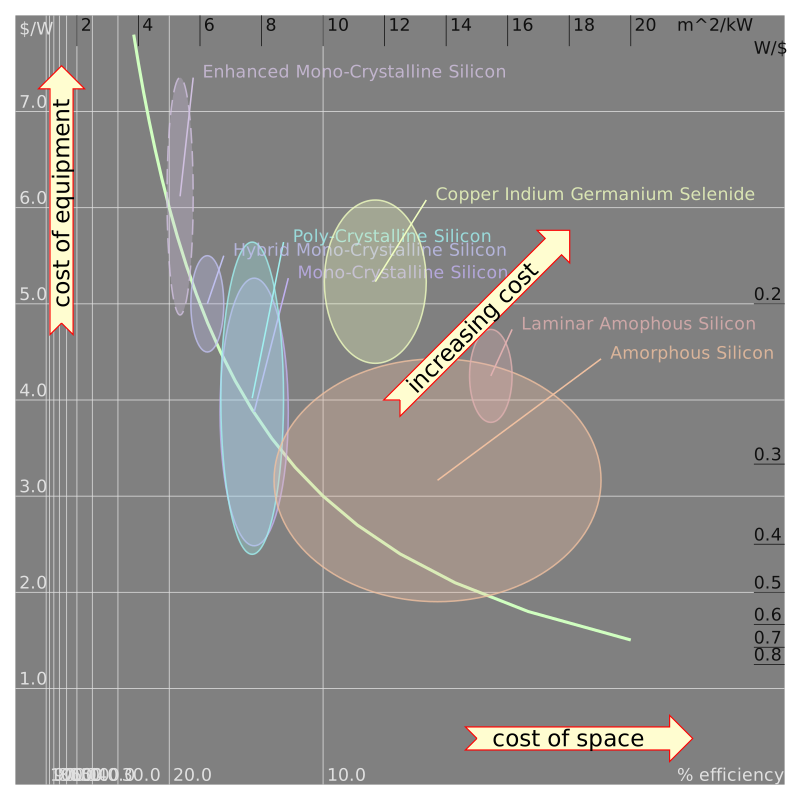 |
 |
| Click on graph to view full-sized SVG version. NOTE: Use the Opera Browser for best results. | ||
The green trend line -- which is the same contour in both domains -- is a hyperbola connecting points of equal resource cost defined my multiplying capital and space footprints.
The distribution of the data indicates a strong inverse correlation between the pairs of variables, such as economy and efficiency. Several features of the plots are noteworthy:
No panels for which we could obtain specifications surpassed 20 percent in efficiency. However, the panels at the upper end of the efficiency range tend to cluster closely around the green trend line. A doubling of efficiency from 10 to 20 percent roughly corresponds to a doubling of the value of the panel, given that a 20-percent-efficient panel commands about twice the price of a 10-percent-efficient panel of comparable output. Continuity of the underlying economic equations suggests that increases of efficiency well above the 20 percent limit would result in further substantial increases in value.